For a while, Los Angeles was the life I imagined for myself.
After graduating from undergrad, I had dreams of heading west. Sunshine, palm trees, opportunity. The whole reinvention package. I had no detailed plan beyond “move to Los Angeles,” which is exactly the kind of planning that makes perfect sense when you are young and convinced life will politely arrange itself around your ambition.
Then life happened.
I met my wife in Ohio, and the imaginary California version of my future gave way to something real: marriage, kids, responsibilities, and a home built far from the Pacific. I never made the move, but I cannot complain about the trade.
Still, Los Angeles remains one of those places that represents the road not taken. Not necessarily a better road. Just another version of life that once felt possible.
For Week 3 of Cook the Competition, that made LA especially interesting. This recipe combines two foods tied to the city: the French dip sandwich and Korean barbecue. It is a collision of old Los Angeles, immigrant Los Angeles, and the ridiculous food instincts of a guy who almost moved there but ended up cooking its story from Ohio instead.
A sandwich with two birth certificates
Despite the name, the French dip is not French. It is an American sandwich born in Los Angeles, although exactly where it was born depends on whom you ask.
Cole’s and Philippe The Original both opened in 1908, and both claimed to have invented it. Cole’s tells a story about a chef dipping bread into beef jus to soften it for a customer with sore gums. Philippe’s tells a different story: founder Philippe Mathieu accidentally dropped a French roll into a roasting pan filled with hot meat juices in 1918, served it anyway, and discovered that people wanted more.
After more than a century, Los Angeles never settled the argument. Honestly, that feels appropriate. A city built on competing stories about who arrived first, who made it big, and whose version gets remembered should probably have two restaurants claiming the same sandwich.
The essential idea survived the debate: thinly sliced beef, sturdy bread, and enough savory jus to make dipping the sandwich part of the meal.
That gave us the first half of the L.A. Double Dip.
The city beyond Hollywood
Los Angeles is easy to flatten into a postcard: celebrities, beaches, traffic, and people drinking suspiciously green things after yoga.
Its food tells a much better story.
Koreatown is one of the clearest examples. Korean immigrants were establishing community institutions in Los Angeles during the early twentieth century, but the modern neighborhood grew significantly after immigration reforms in 1965 brought a new generation of Korean families and entrepreneurs to the city. Businesses, churches, markets, and restaurants helped turn the neighborhood into both a cultural home and an economic center.
It was never an empty neighborhood waiting to become Koreatown, either. Its buildings and streets carry overlapping Korean, Latino, and earlier Los Angeles histories. That mixture is part of what makes the neighborhood feel like the city itself: crowded, complicated, constantly changing, and held together by communities making space for themselves.
Korean barbecue became one of the most visible expressions of that community. It is food built around gathering, with meat cooking at the table, dishes being passed around, and a meal unfolding collectively instead of arriving as one carefully arranged plate.
That gave us the second half.
Building the L.A. Double Dip
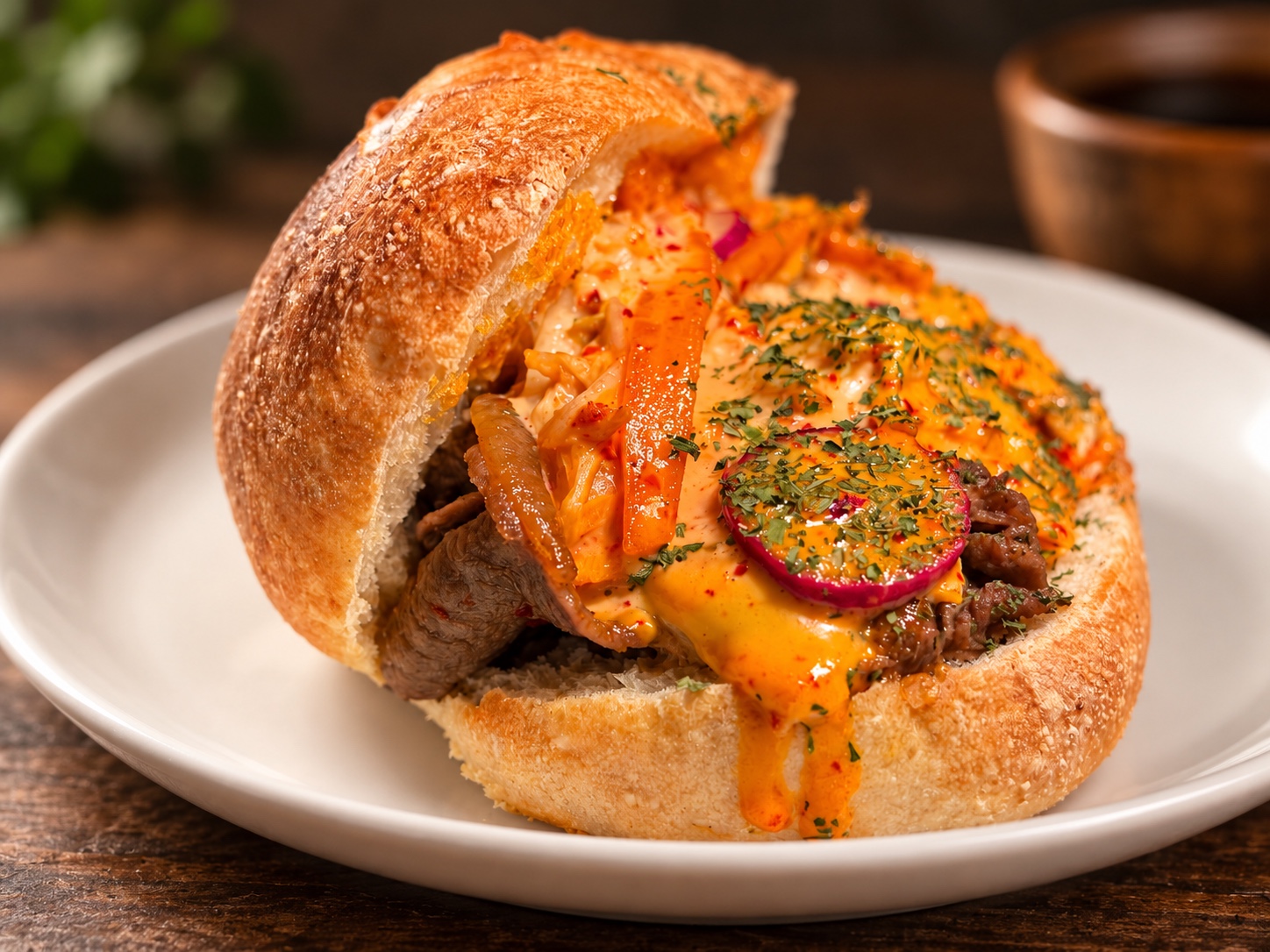
The sandwich starts with thinly sliced sirloin marinated in soy sauce, brown sugar, gochujang, rice vinegar, sesame oil, garlic, and ginger. It gets cooked quickly over high heat until the edges caramelize and the sauce clings to the beef.
Then we pile it onto a toasted French roll with provolone and slowly cooked onions.
At that point, we could stop and have a perfectly respectable Korean barbecue cheesesteak. Respectability, however, has never been the operating principle of The Blackened Ladle.
So we add kimchi slaw for fermentation, acidity, and crunch. Then we build an au jus with beef broth, Worcestershire, sesame oil, soy sauce, and another spoonful of gochujang.
That creates the double dip. The sandwich borrows from two parts of Los Angeles food history, and the jus itself sits somewhere between a traditional French dip broth and Korean barbecue sauce. You can dip carefully along the edge or submerge half the sandwich and accept that your shirt may become part of the meal.
I support both approaches.
Buffalo and the Bolts
The Bills and Chargers go back further than either team’s current city or stadium. Both were original American Football League franchises in 1960, and the Chargers won their first meeting that October.
Historically, this has been a difficult matchup for Buffalo. The Chargers lead the all time series 25 to 14 with two ties and have won four of the past six meetings, although Buffalo took the most recent game in 2023.
For Week 3, Los Angeles travels east to Buffalo. That means the Chargers have to bring West Coast football into an early game at Highmark Stadium, while we bring West Coast food into an Ohio kitchen.
The Bills get Josh Allen.
We get Korean barbecue beef, melted provolone, kimchi slaw, and gochujang au jus.
Everybody has a job.
The road that led here
I still wonder occasionally what life in Los Angeles might have looked like.
Maybe I would have found opportunity there. Maybe I would have lasted six months, spent all my money on rent, and returned to the Midwest with a good story and damaged credit. There is no way to know.
What I do know is that the life I built after meeting my wife is better than the vague dream I had before her. Los Angeles became the city I almost chose. Ohio became the place where my actual life took shape.
That is the funny thing about roads not taken: they do not always disappear. Sometimes they come back years later as inspiration.
In this case, mine came back as a massive sandwich.
The L.A. Double Dip carries the French dip’s disputed Downtown history, the flavors and community of Koreatown, and a little nostalgia for the version of myself who thought California was the next chapter.
He never made it to Los Angeles.
But he would absolutely destroy this sandwich.
Food and matchup reading: Philippe The Original · Los Angeles Public Library · Los Angeles Chargers
Get the L.A. Double Dip recipe →
 WEEK 3