COOK THE COMPETITION · WEEK 5 · LOS ANGELES
Thai Town After Dark
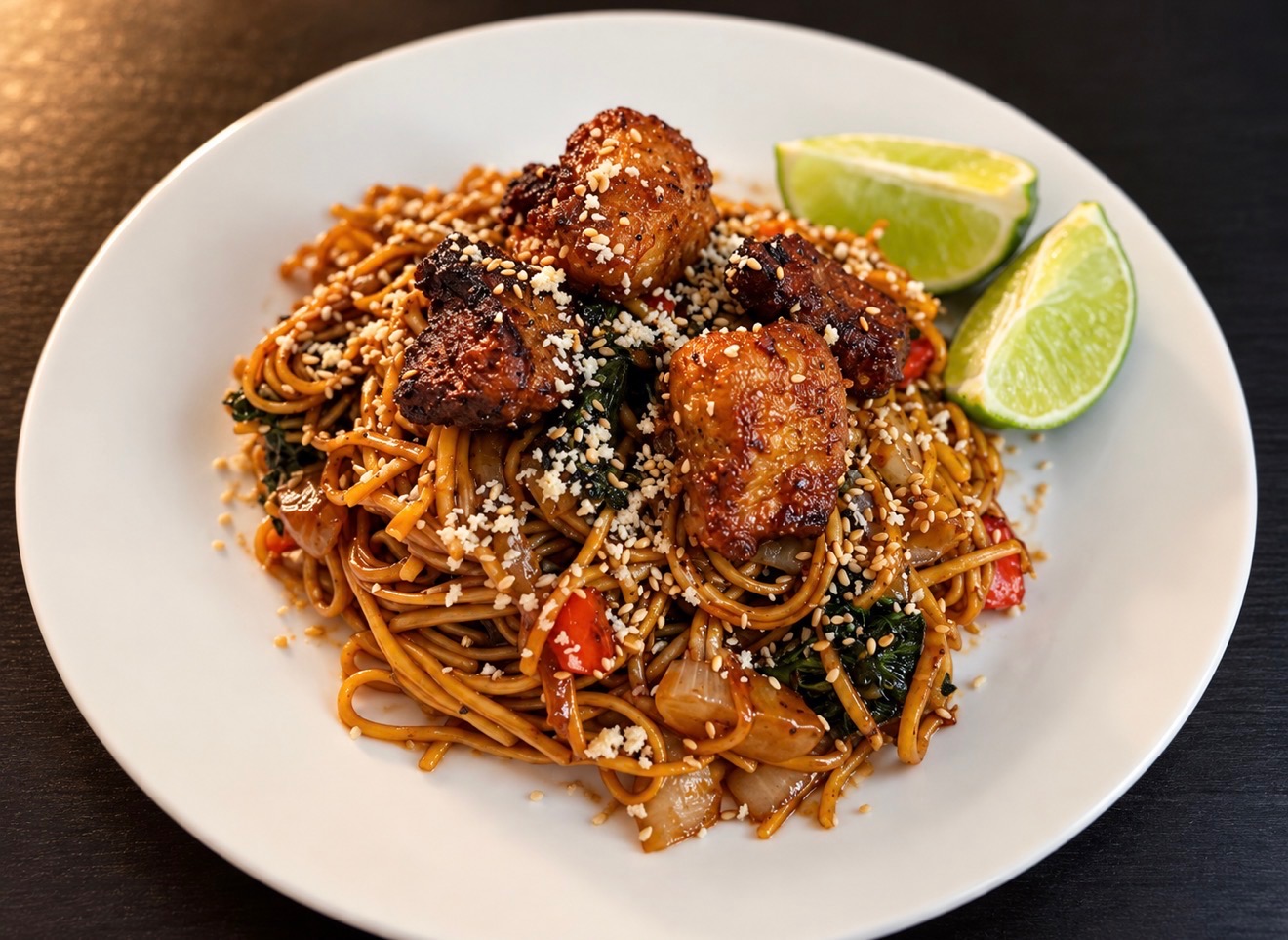
Drunken noodles with crispy pork belly, Thai basil, chiles, vegetables, and a glossy wok-charred sauce.
BILLS VS. RAMS · LOS ANGELES, CA
Thai Town After Dark
A few weeks ago, Cook the Competition landed in Los Angeles for the Chargers and built a Korean barbecue French dip. It was a sandwich inspired by the Los Angeles I used to imagine moving to after college. Sunshine, reinvention, and the possibility that I could become an entirely different person just by changing zip codes.
Then life happened. I met my wife in Ohio, built a family, and discovered that reinvention sometimes looks less like moving across the country and more like cooking ridiculous football food while three children create chaos in the next room.
Now the Bills are heading back to Los Angeles, this time for a Monday night meeting with the Rams.
Going back to the same city presented a problem. Cook the Competition is supposed to explore a new place every week, and we had already cooked Los Angeles.
Except nobody really cooks all of Los Angeles in one meal.
The city is too large, too layered, and too shaped by the communities that built lives inside it. Los Angeles is not one food city. It is dozens of food cities sharing the same traffic problem.
So we are leaving the French dip behind and heading across town to East Hollywood, where Southern California’s Thai community created something that exists nowhere else in America.
Thai Town.
How Thai Town took root
Southern California is home to the largest Thai population outside of Thailand. East Hollywood began serving as a point of entry for Thai immigrants during the middle of the twentieth century, especially after changes to American immigration law in 1965 opened new paths for immigrants from Asia. People came for education, work, family connections, and the possibility of building something new.
Like most immigrant communities, they did not arrive and immediately receive a neighborhood sign.
Community came first.
Thai immigrants found apartments, jobs, schools, temples, markets, and one another. East Hollywood became a place where a newly arrived family could find familiar ingredients, speak Thai, hear about an available job, or get help navigating a city that could feel impossibly large.
Food became part of that support system.
In 1972, Bangkok Market opened in Los Angeles as the first Thai grocery store in the United States. That market did more than sell fish sauce, Thai basil, chiles, and produce that could be difficult to find in American supermarkets. It gave the growing community an anchor. Thai families moved closer. Restaurants opened nearby. Ingredients became easier to obtain, and cooks could prepare food that tasted more like home.
That access helped fuel a Thai restaurant boom across Los Angeles during the 1970s and 1980s.
The early restaurant owners had to introduce the cuisine to customers who sometimes did not even understand that Thailand and Taiwan were different places. Some cooks adjusted the heat, sweetness, and ingredients to make dishes more familiar to American diners. Others found creative ways to bring Thai produce into California. Over time, the food became more regional, more confident, and more reflective of the families cooking it.
Thai food did not simply become popular in Los Angeles. Los Angeles became one of the places where Americans learned what Thai food could be.
The neighborhood finally received official recognition in 1999, after an eight year campaign led by the Thai Community Development Center. The Los Angeles City Council designated a stretch of Hollywood Boulevard between Western and Normandie as Thai Town, making it the first officially recognized Thai Town in the country. It remains the only one.
That designation was about more than putting a name on a sign.
It was a way for the community to say that Thai people had built something here. Their restaurants, markets, businesses, traditions, and families were part of Los Angeles history. Thai Town gave the community greater visibility while helping neighborhood businesses attract customers and remain economically viable.
It also gave Los Angeles another reason to eat very well.
When food carries the story
For years, Thai restaurants were often the most visible part of the Thai American experience. That visibility was valuable, but it could also flatten an entire community into a takeout menu. Historian Mark Padoongpatt initially resisted writing about food for that reason. He wanted to tell the deeper history of Thai Americans, including immigration, labor, and the challenges families faced while building lives in the United States.
What he discovered was that food was where much of that history had been preserved.
Restaurant owners had been interviewed. Menus had survived. Grocery stores had become neighborhood landmarks. Recipes showed how immigrants adapted to America while holding on to home. Food was not distracting from the story. Food was carrying it.
That idea sits at the heart of Cook the Competition.
We make something fun and probably larger than medically necessary, but the recipe gives us a way into the people behind the food.
For Rams week, that path leads directly to drunken noodles.
Building Thai Town After Dark
Drunken noodles, known as pad kee mao, have been my favorite Thai dish for years. They are spicy, savory, garlicky, loaded with basil, and built around wide rice noodles that soak up sauce while picking up a little char from a hot wok.
Despite the name, there is no alcohol in the dish.
The exact origin of the name is debated. One story says it became popular as food for people coming home after a night of drinking. Another says the heat and bold seasoning make it an ideal partner for a cold drink. It may have been made from whatever ingredients a hungry cook could find after a late night.
The history is uncertain, but the personality is not.
Pad kee mao is not shy food.
It arrives glossy and fragrant, with enough chile and garlic to wake up every part of your face. Thai basil brings a peppery, almost anise like freshness. Fish sauce and oyster sauce provide deep savory flavor. Wide rice noodles carry everything while vegetables add crunch and color.
It is exactly the kind of dish that belongs under Monday night lights.
Our version is called Thai Town After Dark, and because this is The Blackened Ladle, we decided a normal serving of noodles was only the beginning.
We start with cubes of pork belly seasoned with fish sauce, soy sauce, brown sugar, garlic, and black pepper. A light coating of cornstarch helps the outside become deeply browned and crisp while the inside stays rich and tender.
Then we build the noodles with garlic, Thai chiles, onions, red bell pepper, Chinese broccoli, and fresh Thai basil. Oyster sauce, soy sauce, fish sauce, dark soy, rice vinegar, and chile garlic sauce create that salty, spicy, slightly sweet coating that clings to every fold of the rice noodles.
The crispy pork belly goes on top because placing it politely beside the noodles would suggest we suddenly developed restraint.
Then come the fried rice noodle strips.
Those are not traditional. They are here because crispy noodles piled on top of chewy noodles felt exactly ridiculous enough for this series. They add height, crunch, and the very real possibility that part of dinner will land on your shirt.
This is not intended to replace traditional pad kee mao or pretend that a home kitchen in Ohio can speak for the whole of Thai cuisine. It is our game day riff, built with respect for the dish that inspired it and the Los Angeles community that made Thai food part of the American food landscape.
The Rams return to Los Angeles
The Rams provide another Ohio connection hiding inside a Los Angeles story. The franchise began in Cleveland in 1937 before moving west in 1946. The team eventually spent two decades in St. Louis before returning to Los Angeles in 2016.
Apparently even the Rams once looked at Ohio and started dreaming about Los Angeles.
I understand the feeling.
Bills and Rams games have also developed a habit of becoming memorable. Buffalo opened its 2022 season in Los Angeles against the defending champions. When the teams met again in 2024, they produced the kind of frantic afternoon that left both fan bases exhausted and every defensive coach searching for a quiet room.
Now they meet again on Monday night.
For Buffalo, it is a chance to respond under the lights. For this series, it is a chance to prove that returning to the same city does not mean telling the same story.
The Chargers gave us the Los Angeles of Korean barbecue, old sandwich counters, and a road I once thought I might take.
The Rams give us East Hollywood after dark. A neighborhood shaped by Thai immigrants who created businesses, fed one another, adapted without disappearing, and fought to have their community officially recognized.
That deserves more than a passing mention beside a plate of noodles.
It deserves the whole meal.
Thai Town After Dark is hot, loud, deeply savory, a little messy, and built from more layers than you expect at first glance.
In other words, it feels a lot like Los Angeles.
Grab the widest noodles you can find. Get the wok hotter than seems reasonable. Do not be afraid of the garlic. Keep a cold drink close and a stack of napkins closer.
The Bills are back in Los Angeles, and this time we are cooking after dark.
Same city. Different team. Entirely new flavor. Rams, you are officially on the menu.
Sources and further reading: Advisory Council on Historic Preservation · Thai Community Development Center · PBS SoCal · USC Dornsife · Pro Football Hall of Fame · Los Angeles Rams
Method
- Prep the pork belly.Cut the pork belly into 1-inch cubes. Toss with fish sauce, soy sauce, brown sugar, garlic, and pepper. Let marinate 20 to 30 minutes. Pat dry, then toss with cornstarch.
- Cook the pork belly.Heat 2 tablespoons oil in a large skillet or cast iron pan over medium-high heat. Add the pork belly in a single layer and cook, turning, until crispy and deeply browned on all sides, 12 to 15 minutes. Remove and set aside.
- Make the sauce.In a small bowl, whisk together the oyster sauce, soy sauce, fish sauce, dark soy sauce, brown sugar, rice vinegar, and chili garlic sauce. Set aside.
- Prepare the noodles.If using dry noodles, soak them in very warm water for 20 to 30 minutes until pliable. Drain well. They will finish cooking in the wok.
- Stir-fry.Heat 1 tablespoon oil in a large wok or skillet over high heat. Add the garlic and chiles and stir for 30 seconds. Add the onion, bell pepper, and Chinese broccoli. Stir-fry 2 to 3 minutes until slightly charred but still crisp.
- Combine.Add the soaked noodles and sauce. Toss and stir-fry 2 to 3 minutes, letting the noodles pick up color and get slightly charred. Add the crispy pork belly and most of the basil leaves. Toss until everything is glossy and well coated.
- Finish.Remove from the heat. Top with the remaining fresh basil, crispy fried noodle strips, extra chiles, and a squeeze of lime.
THE TABLE IS OPEN
Rate this recipe
How many ladles would you give it?
Comments
Loading comments…