COOK THE COMPETITION · WEEK 6 · BILLS vs. RAIDERS
Oakland Soul Game Day Menu
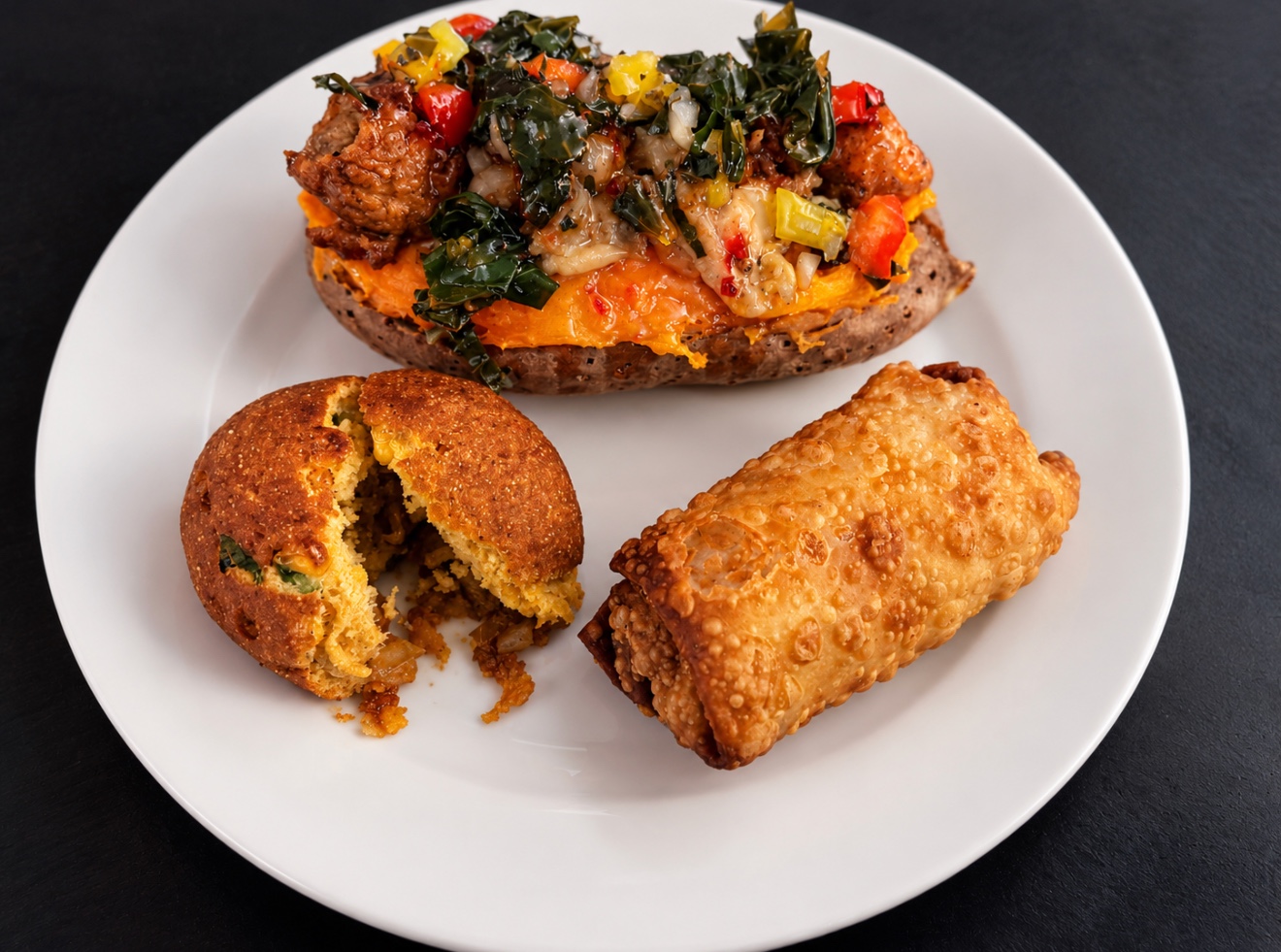
Three recipes make one Oakland-inspired spread: brisket, pimento mac, and collard egg rolls; brown-butter sourdough hush puppies stuffed with smoky bacon-onion jam; and a twice-baked sweet potato piled with Smoked Orchard sourdough-buttermilk chicken, chow-chow, and pepper-jelly glaze.
COOK THE COMPETITION · WEEK 6
Oakland Soul
Buffalo Bills vs. Las Vegas Raiders
Game location: Las Vegas, Nevada
Culinary inspiration: Oakland, California
This is one of those weeks when the helmet says one city, but the recipe tells the story of another.
The Raiders play in Las Vegas now. The lights are brighter, the stadium is newer, and everything surrounding the team carries the polish of the Strip. But the identity underneath all that silver and black was not created in a casino.
It was forged in Oakland.
That is where the Raiders began playing in 1960. It is where the franchise developed its rebellious personality, built Raider Nation, and became inseparable from a city that has never needed anyone’s permission to be itself.
So we are not cooking Las Vegas this week.
We are going back to Oakland.
More specifically, we are going to West Oakland and Seventh Street, where Black migration, music, nightlife, barbecue, entrepreneurship, and community organizing came together to create one of the most important cultural corridors on the West Coast.
This week’s menu includes Oakland Jackpot Egg Rolls filled with smoked brisket, pimento macaroni and cheese, and braised collard greens; Brown-Butter Sourdough Hush Puppies stuffed with smoky bacon-onion jam; and an enormous Oaktown Sweet Potato Volcano topped with crispy hot honey chicken, collard chow chow, smoked cheddar, and a warm pepper jelly glaze.
None of these dishes is a traditional Oakland recipe.
They are our interpretations of the food traditions that traveled to Oakland with Black families from the South, took root in the East Bay, and became part of the city’s identity.
The people who brought the food west
To understand why those ingredients belong together, we have to start with the people who brought them west.
Oakland already had a growing Black community before World War II, but wartime jobs transformed the city. Black workers and their families arrived from Louisiana, Texas, Arkansas, Alabama, Mississippi, and other parts of the South looking for opportunities in shipyards, factories, railroads, and ports.
They carried more than suitcases.
They brought music, church traditions, family recipes, pit barbecue techniques, and an understanding that food could stretch beyond the dinner table. It could welcome a new neighbor, raise money for a church, support a business, or feed a child before school.
Southern dishes such as slow cooked collard greens, baked sweet potatoes, fried chicken, macaroni and cheese, and smoked meats followed families across the country during the Great Migration. The ingredients stayed familiar, but the communities serving them were building something new. (nps.gov, americanhistory.si.edu)
Seventh Street
In West Oakland, much of that new life gathered around Seventh Street.
During the first half of the twentieth century, Seventh Street became the center of Black jazz and blues culture in the Bay Area. The corridor was lined with restaurants, supper clubs, bars, barber shops, stores, and hotels. Its connection to rail, streetcar, and ferry lines made it a natural gathering place for workers, travelers, musicians, and families establishing themselves in the city. (oaklandca.gov)
Slim Jenkins opened his famous cafe on Seventh Street in 1933, on the same day Prohibition ended. That is either excellent planning or the kind of timing that becomes family legend.
His club became one of the anchors of the neighborhood’s nightlife. Later establishments such as Esther’s Orbit Room and Eli’s Mile High Club kept the music going. On any given night, the corridor might carry the sounds of blues, jazz, and rhythm and blues from performers such as Big Mama Thornton, Sugar Pie DeSanto, Lowell Fulson, and Jimmy McCracklin. (oaklandlibrary.org)
Seventh Street was sometimes called the Harlem of the West, but it was never simply a California imitation of another city.
It had its own rhythm.
The clubs provided stages for Black musicians. Restaurants fed performers after shows. Local businesses employed neighbors and circulated money through the community. People came for dinner, stayed for the music, and probably remained long enough to make decisions they reconsidered the following morning.
Food and nightlife were not separate stories. They were part of the same ecosystem.
Oakland barbecue
Oakland barbecue grew inside that world.
Its foundations came from Southern pit traditions carried west by Black migrants. Over time, Oakland developed a barbecue identity known for meat cooked over wood, generous portions, and dark sauces that leaned sweet, smoky, tangy, and hot.
Flint’s Barbecue became one of the city’s most celebrated barbecue institutions after opening in 1968. Dorothy Everett, who had migrated from rural Alabama, worked at Flint’s smoke pit before opening Everett and Jones with her children in 1973. The family built a lasting Oakland business with its barbecue, sauces, and the work of a remarkable group of women pitmasters. (eandjbbq.com, kqed.org, oacc.cc)
That history is the inspiration behind the Oakland style barbecue sauce served with our egg rolls.
We are building ours with tomato, brown sugar, apple cider vinegar, smoked spices, and enough heat to hang around after the bite is gone. We are not claiming to reproduce a guarded family recipe. Oakland barbecue families have protected those sauces for generations, and I have no interest in starting a sauce related investigation from my kitchen in Ohio.
We are borrowing the personality.
Rich. Tangy. Smoky. A little sweet. Not remotely interested in being ignored.
Building the Oakland Jackpot Egg Rolls
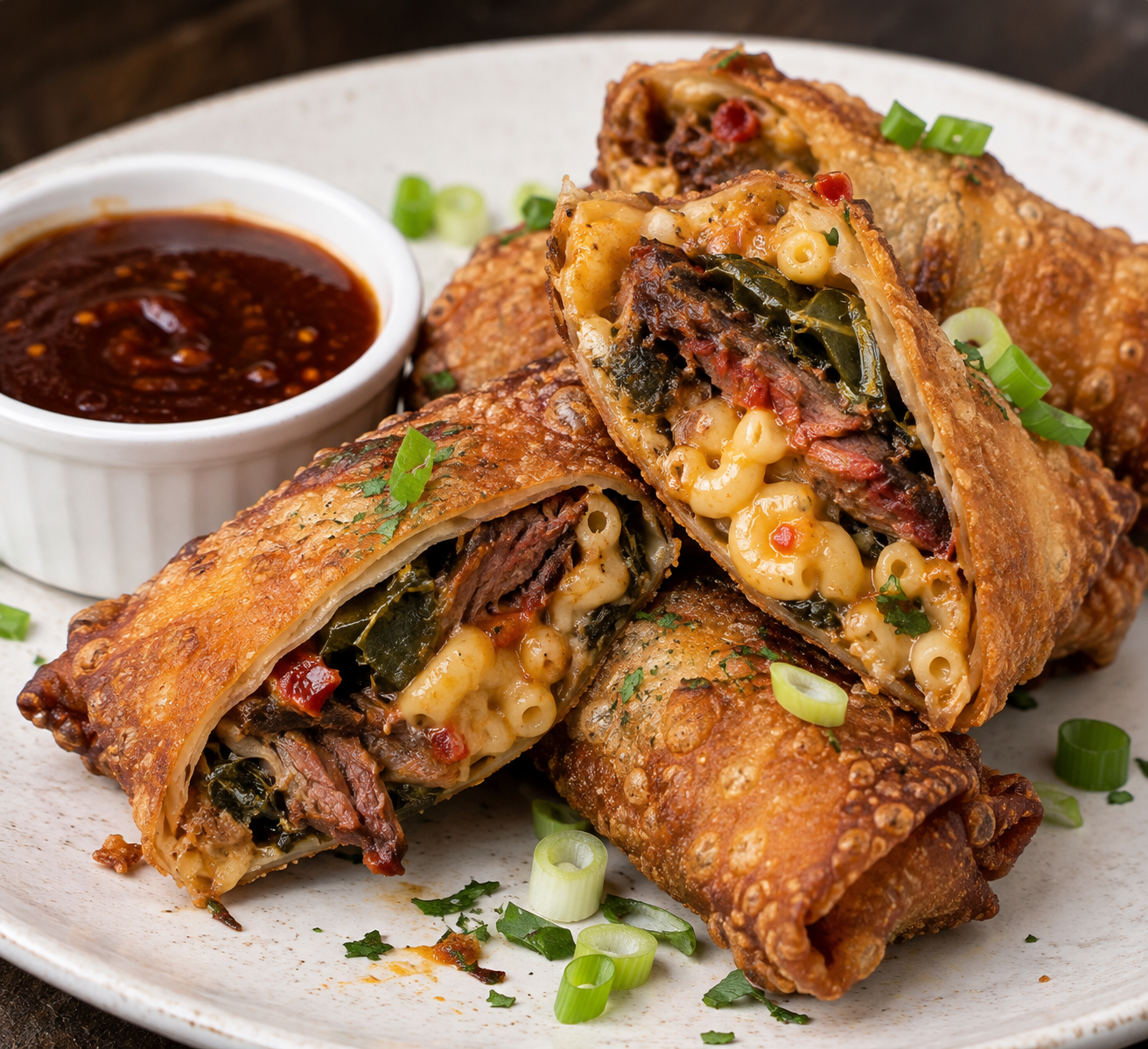
The egg rolls begin with smoked brisket, chopped and sauced. We add creamy pimento macaroni and cheese and braised collard greens, wrap everything tightly, then fry it until the shell turns golden and shatters when you bite into it.
Egg rolls are not a historic Seventh Street barbecue dish. Stuffing an entire barbecue plate inside one is our contribution to the situation.
It is a contemporary format carrying flavors connected to Oakland’s Black food history. The brisket nods to the city’s smoke pits. The macaroni and cheese and collards reflect Southern cooking traditions carried west. The wrapper simply allows us to hold all of it in one hand while pretending this counts as an appetizer.
It does not.
One of these egg rolls is practically a small lease agreement.
One more bite for the table
The Brown-Butter Sourdough Hush Puppies take that same barbecue spirit and hide it inside a golden shell. Sweet potato, charred corn, jalapeños, and active starter surround a chilled center of smoky bacon-onion jam.
Smoked honey butter goes on while they are hot, and a mustard sauce sharpened with our Smoked Orchard pickle brine keeps every bite from getting too comfortable.
Building the Oaktown Sweet Potato Volcano
The Oaktown Sweet Potato Volcano takes the same history in a different direction.
Sweet potatoes became a staple of Black Southern cooking long before families carried them into cities across the North and West. They could be roasted, mashed, candied, or baked into pies. They were affordable, adaptable, and capable of moving between the main plate and dessert without asking anybody’s permission.
Our version starts with an enormous sweet potato roasted until the inside becomes soft and caramelized. We scoop it out and whip it with brown butter, roasted garlic, and smoked cheddar before piling it back into the skin.
That alone would be plenty.
We then cover it with crispy hot honey chicken bites and a tangy collard chow chow made with chopped greens, bell peppers, onions, and pickled peppers. A warm pepper jelly glaze runs down the sides like lava.
Hence the volcano.
This is not an old Oakland dish uncovered in somebody’s recipe box. No grandmother on Seventh Street was casually serving a potato carrying enough toppings to require structural engineering.
It is our own oversized tribute to the ingredients and cooking traditions that traveled with Black families to the East Bay.
The collard chow chow is especially important. Greens are usually treated as the slow cooked side dish, but here they become bright, crunchy, acidic, and sharp enough to cut through the sweet potato, cheese, fried chicken, and glaze.
Because even ridiculous food needs balance.
Food as power
Oakland’s relationship with food also extends far beyond restaurants.
The Black Panther Party was founded in Oakland in 1966. While the organization is often remembered through images of leather jackets and armed resistance, its work also included health clinics, food distribution, education, and direct community support.
In 1969, the Party began its Free Breakfast for School Children Program in Oakland. Members and volunteers prepared hot meals because they understood something simple and powerful. A hungry child cannot be expected to learn. The program quickly grew and became one of the organization’s best known community survival programs. (oaklandlibrary.org, museumca.org, nmaahc.si.edu)
That history gives food a different meaning in Oakland.
Food can be pleasure. It can be business. It can be culture and family memory.
It can also be power.
It can say that the people in a community deserve to be nourished, protected, and given the chance to thrive.
That is why reducing Oakland food to one famous restaurant or one signature dish misses the point. The deeper story is about what people built around the table.
Much of old Seventh Street was damaged by urban renewal, freeway construction, BART development, and other projects that displaced residents and cut through the neighborhood. Clubs closed. Businesses disappeared. The corridor changed.
But the culture did not simply vanish.
It lives in music, family businesses, neighborhood organizing, barbecue smoke, and recipes carried across generations. Oakland’s history is filled with people creating something lasting even when the city around them kept changing.
Buffalo, Oakland, and the old AFL
The Raiders fit that story better than their current address might suggest.
Buffalo and Oakland entered professional football at nearly the same moment. The Bills were admitted to the new American Football League in 1959, and the Raiders joined as its eighth team in 1960. Both franchises began play that year as members of a league trying to challenge the established NFL. (raiders.com, buffalobills.com)
The connection became even more direct in 1962, when Bills owner Ralph Wilson loaned the struggling Raiders four hundred thousand dollars to help keep the franchise alive and preserve the AFL’s eight team structure. (buffalobills.com)
Buffalo helped keep Oakland football standing.
Years later, the Raiders stood between the Bills and their first Super Bowl appearance. That AFC Championship meeting became one of the defining moments in Buffalo football history.
The uniforms have changed slightly. The league grew. The Raiders moved from Oakland to Los Angeles, returned to Oakland, and eventually left for Las Vegas.
But when Buffalo plays the Raiders, there is still a piece of the old AFL on the field.
There is also a connection between two fan bases built around cities that are frequently misunderstood from the outside.
Buffalo and Oakland know what it feels like to have somebody else explain your city to you. They know how quickly outsiders reduce a community to decline, crime, weather, or an old punchline. They also know that the people who actually live there tell a more complicated story.
These are cities shaped by working families, migration, music, food, resistance, and an almost unreasonable amount of hometown loyalty.
That deserves a meal with some weight behind it.
The soul of the Town
The Oakland Jackpot Egg Rolls are smoky, creamy, crispy, and messy enough to require strategy.
The Oaktown Sweet Potato Volcano is sweet, spicy, savory, tangy, and large enough to have its own weather system.
The Brown-Butter Sourdough Hush Puppies hide charred corn, sweet potato, and smoky bacon-onion jam inside one deeply golden bite.
None is pretending to be a historic Oakland recipe.
Together, they tell our version of the story. Southern food carried west. Barbecue smoke rising from Black owned businesses. Collards and sweet potatoes transformed without losing the history they carry. A little fusion. A lot of excess. No interest in making the plate quiet or polite.
The Raiders may play beneath the lights of Las Vegas now, but the soul of the silver and black was built beside the port, the rail lines, the clubs, and the smoke pits of Oakland.
That is the city we are cooking.
The Raiders left Oakland, but Oakland never left the Raiders. This week, the soul of the Town is on the menu.
PART ONE · 12 ROLLS
Oakland Jackpot Egg Rolls
Smoked brisket, pimento mac and cheese, and braised collards in a crisp wrapper with Oakland-inspired barbecue sauce.
Make the egg rolls →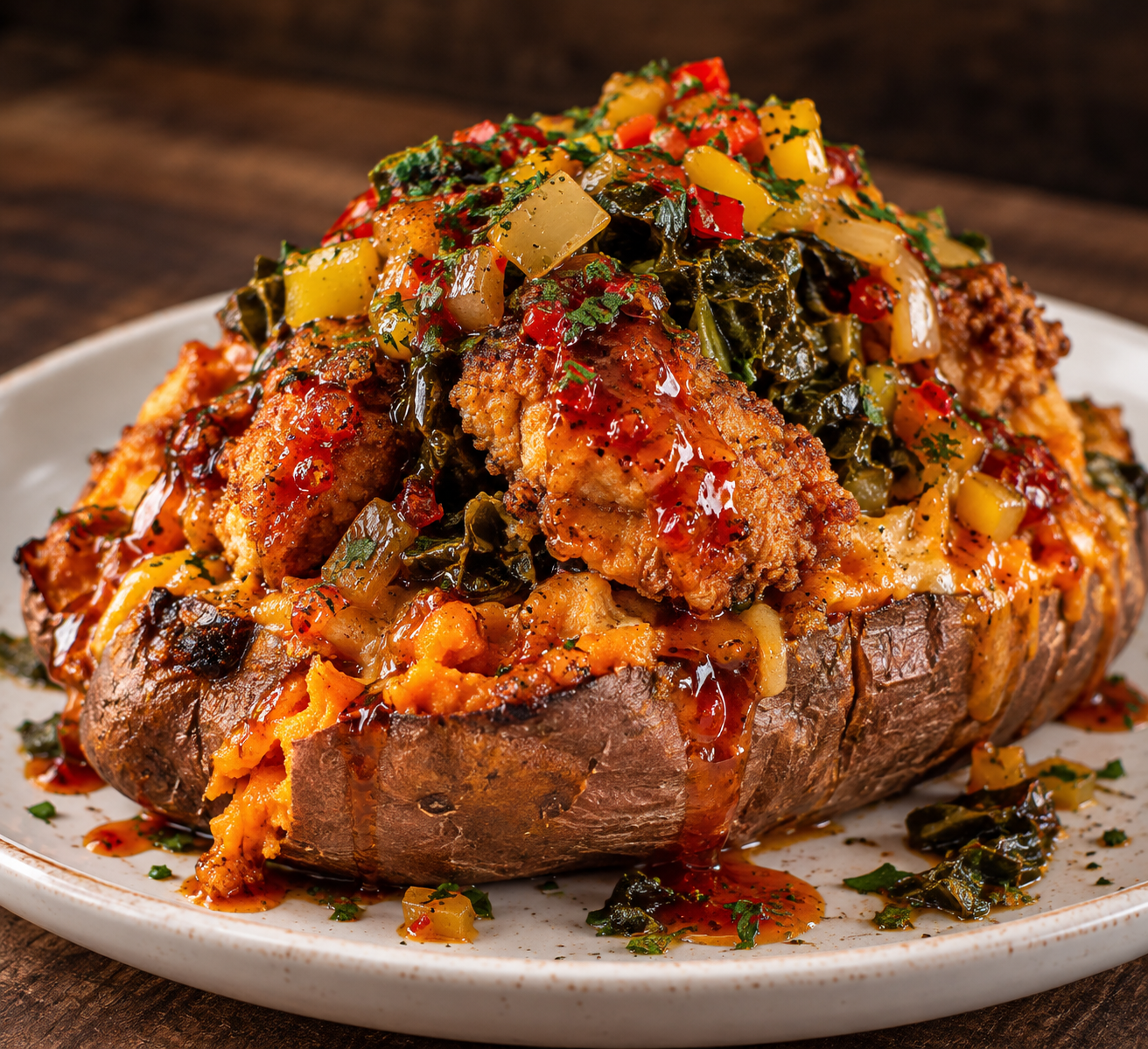
PART TWO · 4 SERVINGS
Oaktown Sweet Potato Volcano
Brown-butter sweet potato, Smoked Orchard sourdough-buttermilk chicken, collard chow-chow, and pepper-jelly glaze.
Build the volcano →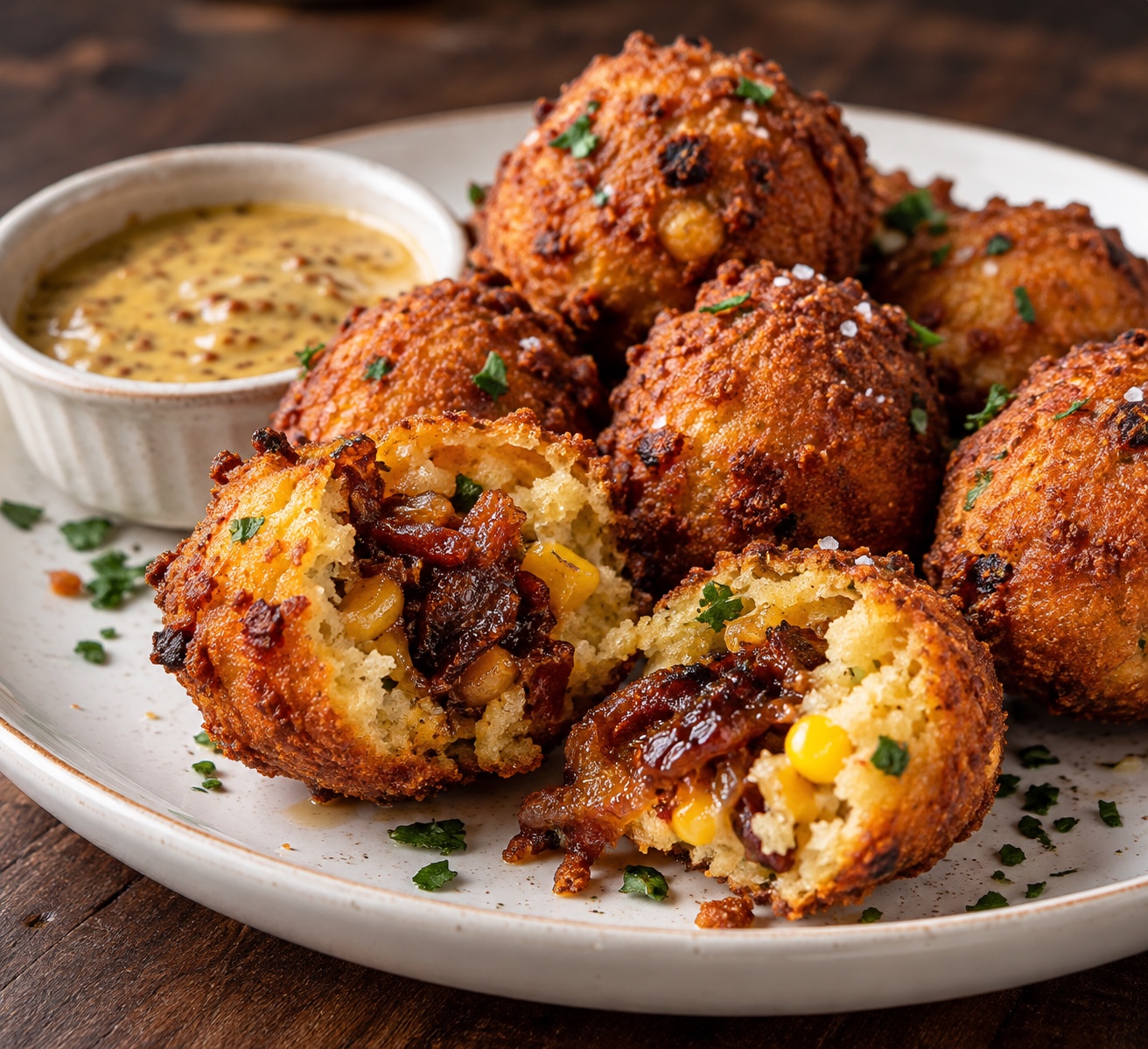
PART THREE · 18–20 HUSH PUPPIES
Brown-Butter Sourdough Hush Puppies
Brown-butter sweet-potato sourdough fritters with charred corn, jalapeños, bacon-onion jam, and Smoked Orchard mustard sauce.
Fry the hush puppies →THE TABLE IS OPEN
Rate this recipe
How many ladles would you give it?
Comments
Loading comments…