COOK THE COMPETITION · WEEK 4 · BOSTON
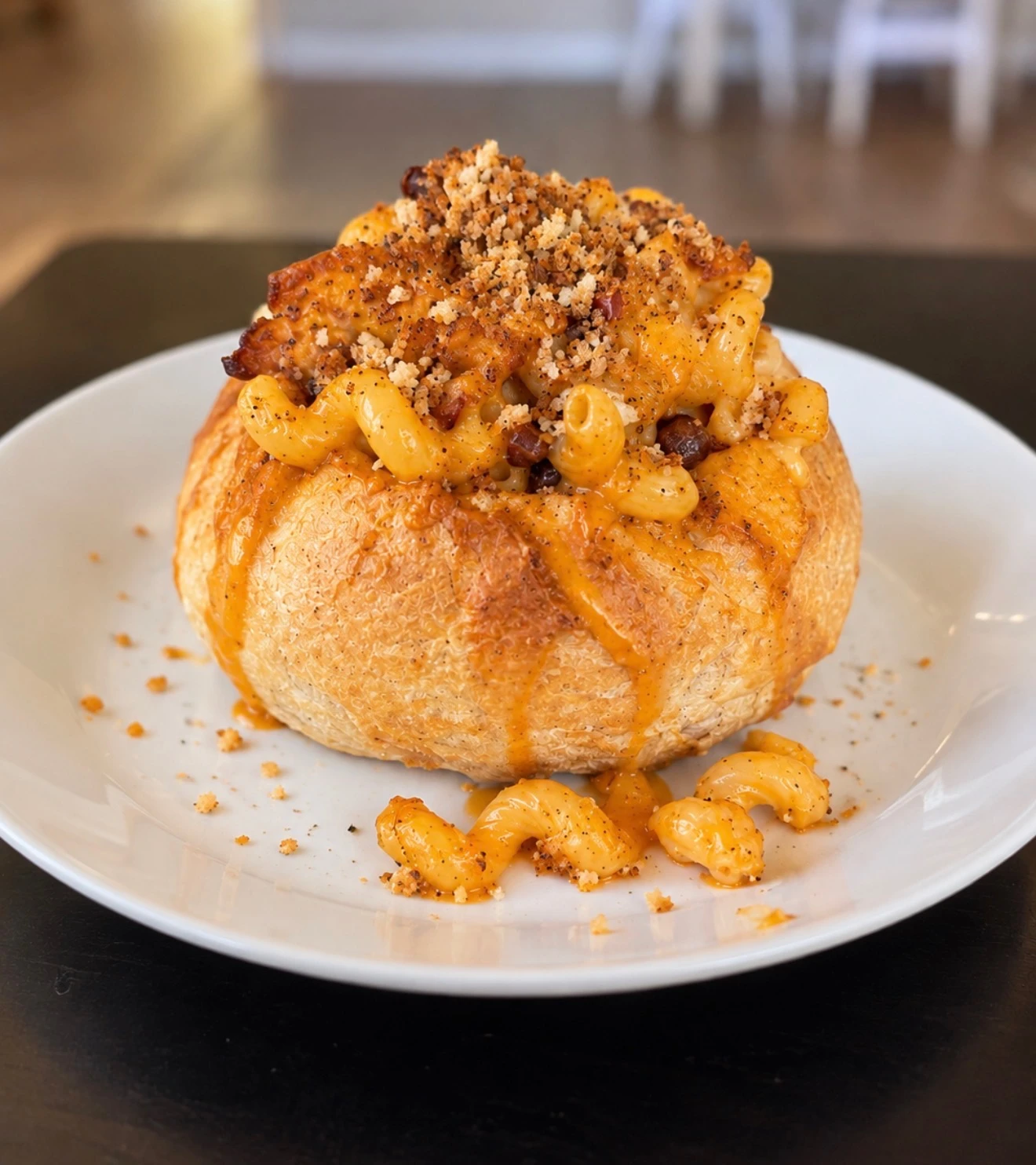
Beantown Breadbowl Mac & Cheese
Creamy cheddar mac packed with smoky bacon, Boston baked beans, and maple breadcrumbs in a crusty sourdough bowl.
PATRIOTS AT BILLS · BOSTON, MA
How Boston became Beantown, and how we cooked it.
Boston and Buffalo both know what it is like to have a nickname take on a life of its own.
There are not actually buffalo wandering around Buffalo, and modern Boston is not exactly overflowing with bean pots. Still, the names stuck. Outsiders hear them and think they understand the city before ever meeting the people who live there.
Both cities are much more complicated than the shorthand.
Boston gets reduced to the Revolution, old brick buildings, expensive colleges and an aggressive relationship with the letter R. Buffalo gets snowstorms, chicken wings and folding tables with increasingly short life expectancies.
Behind the stereotypes are two northern cities shaped by water, immigration, industry, neighborhood pride and the belief that suffering through winter builds character. That history made Boston an easy city to cook for. The hard part was deciding how ridiculous we were willing to get.
The answer was macaroni and cheese, smoky bacon and Boston baked beans packed into a crusty sourdough bread bowl, then finished with maple breadcrumbs.
So, fairly ridiculous.
Beans, Boston and the history inside the pot
Beans were part of New England food long before anyone started calling Boston Beantown. Indigenous communities throughout the Northeast cultivated beans alongside corn and squash. Stories connecting those traditions directly to modern Boston baked beans are sometimes presented too neatly, but Indigenous agriculture and cooking unquestionably shaped the foodways European colonists encountered.
The familiar Boston version developed around navy beans cooked slowly with pork and molasses. For Puritan households, a pot of beans could be prepared on Saturday and kept warm through Sunday, allowing families to observe the Sabbath without cooking a new meal. What began as practical food became a weekly tradition.
Molasses gave the beans their dark color and deep sweetness, but it also carries a harder part of Boston’s history. Colonial Boston was a major Atlantic trading port. Molasses arrived from Caribbean sugar plantations where production depended heavily on enslaved labor. New England merchants used it for food, but they also distilled it into rum that circulated through an economy tied directly to slavery.
That history does not make baked beans less connected to Boston. It makes the connection more honest. Food can carry comfort, community and injustice in the same pot. Boston baked beans reflect Indigenous influence, English colonial cooking, Puritan tradition, Atlantic commerce and the labor of people who rarely received a choice or credit in the story.
How Boston became Beantown
Boston’s association with beans was already well established by the late nineteenth century, but a massive homecoming celebration helped make the nickname famous. During Boston’s 1907 Old Home Week, the city used the bean pot as a symbol of hospitality and local identity. Promotional materials featured the pot, and roughly one million stickers were printed showing clasped hands above a traditional Boston bean pot.
It was essentially an early tourism campaign. Come home, spend some money, remember how much you love Boston and have some beans while you are here.
The promotion worked a little too well. More than a century later, plenty of Bostonians roll their eyes at Beantown, but the nickname refuses to leave.
That history became the foundation for this week’s Beantown Breadbowl Mac & Cheese.
Building the Beantown bread bowl
We start with a loose cheddar cheese sauce made with milk, chicken stock and cream. The sauce is intentionally thinner than standard macaroni and cheese because a bread bowl is basically an edible sponge with ambition. If the sauce starts too thick, the bread absorbs the moisture and dinner turns into a cheesy brick.
Into that sauce goes macaroni, crisp bacon, caramelized onion and Boston baked beans. The beans bring molasses sweetness, smoke and a soft texture that works surprisingly well against the pasta. The bacon adds salt and richness, while the onions bridge the sweet and savory sides of the dish.
The mixture gets spooned into a hollowed sourdough boule and topped with buttery breadcrumbs, Parmesan, smoked paprika and maple syrup.
The bread bowl gives a nod to the old New England pairing of baked beans and brown bread. The maple reaches further back toward the region’s earlier sweetening traditions. The macaroni and cheese brings us firmly back to a house with small children and absolutely no interest in historical restraint.
This is not a museum recreation of a colonial meal.
It is what happens when Boston food history meets football Sunday in The Blackened Ladle kitchen.
A rivalry with a long memory
The matchup itself carries even more history.
The Bills and Patriots first met in 1960 as members of the new American Football League. They have played more than 130 times since then, and New England has held the overall edge. No opponent has lost to the Patriots more often than the Bills.
For Buffalo fans of my generation, the rivalry is impossible to separate from the Tom Brady years. New England won 15 straight meetings from 2003 through 2010. Brady finished with 30 regular season victories over Buffalo, more than he recorded against any other opponent.
For years, Patriots week felt less like a rivalry and more like a scheduled reminder that life is unfair.
Then the balance began to shift.
Josh Allen and the Bills finally produced the moment Buffalo fans had been waiting for during the January 2022 Wild Card game. Buffalo scored touchdowns on all seven of its offensive possessions. The Bills did not punt, attempt a field goal or turn the ball over. It was the first game in NFL history in which a team completed all three of those feats.
After two decades of frustration, Buffalo did not simply beat New England. They played a perfect offensive game and ended the Patriots’ season in freezing Orchard Park.
That history is part of why this rivalry still matters even as the players and coaches change. Buffalo remembers what it felt like to spend years underneath New England. Patriots fans remember when Buffalo was simply another box to check on the schedule. Neither side has forgotten, and neither fan base is especially interested in behaving normally about it.
Two northern cities that refuse to disappear
The cities themselves share some of that same stubbornness.
Boston grew around its harbor and Buffalo around Lake Erie and the western end of the Erie Canal. Water connected both cities to larger markets and helped turn them into centers of trade, industry and immigration. Their growth created fortunes, but it also depended on difficult labor and systems that did not distribute those fortunes equally.
When industries changed and neighborhoods struggled, both cities learned to protect their identity fiercely. Sports became part of how each place told its story. The teams were not just entertainment. They became proof that the city still mattered.
Boston eventually collected enough championships to become unbearable about it.
Buffalo collected heartbreak and somehow turned that into community.
This week, the Patriots come to Orchard Park for their first game inside the new Highmark Stadium. The uniforms will be different from the ones that began this rivalry in 1960, but the feeling will be familiar.
Two old northern cities. Two fan bases convinced the other one is a problem. One division game carrying decades of memories.
Boston brings the Patriots.
We bring the bread bowls.
Inside ours is creamy macaroni and cheese, smoky bacon, caramelized onions, maple breadcrumbs and the beans that gave an entire city its nickname.
Beantown has officially been cooked.
Method
- Prepare the bread bowls.Heat the oven to 375°F. Cut the tops from the boules and hollow out the centers, leaving about ½ inch of bread on the sides and bottom. Brush the insides and tops with melted butter, garlic, garlic powder, and salt. Bake 8 to 10 minutes until lightly crisp. Set aside.
- Cook the pasta.Bring a large pot of salted water to a boil. Cook the pasta 1 to 2 minutes less than al dente. Drain and reserve 1 cup of pasta water.
- Cook the bacon and onion.Cook the bacon until crisp, then chop. In the same skillet, add the diced onion and cook until caramelized and soft. Set aside.
- Make the loose cheese sauce.Melt butter over medium heat. Whisk in flour and cook 1 minute. Slowly whisk in milk, chicken stock, and cream. Bring to a gentle simmer, whisking constantly, until slightly thickened, about 3 to 4 minutes. Stir in Dijon, garlic powder, paprika, salt, and pepper. Reduce heat to low and add the cheddar, white cheddar, and American cheese. Stir until melted and smooth. The sauce should be creamy and slightly thinner than traditional macaroni and cheese. Loosen with reserved pasta water if needed.
- Combine.Add the pasta, bacon, caramelized onions, and baked beans to the cheese sauce. Stir gently. Keep the mixture very creamy and slightly loose because it will thicken in the oven and as it sits in the bread bowl.
- Make the topping.Mix the panko, melted butter, maple syrup, Parmesan, and smoked paprika in a small bowl.
- Assemble and bake.Fill each bread bowl with the macaroni and cheese mixture, letting it mound slightly. Top with maple breadcrumbs and a little extra cheese if desired. Bake at 400°F for 6 to 8 minutes, just until hot and the topping is golden and crisp.
- Serve.Garnish with chopped parsley and green onions. Serve immediately while the macaroni is creamy and the bread is crisp.
THE TABLE IS OPEN
Rate this recipe
How many ladles would you give it?
Comments
Loading comments…